
Sales productivity in field sales and distribution is not simply a measure of how much a team sells. It is a measure of how much time and effort is required to generate that output. A team generating the same revenue while spending 40 percent of its day on administrative tasks is not a productive team — it is an under-utilised one.
Field force automation software addresses this directly. By digitizing and automating the repetitive, manual elements of the field sales process — order taking, visit recording, collection follow-up, reporting — it frees sales representatives to focus on what actually generates revenue: visiting more customers, placing accurate orders, and building the relationships that drive repeat business.
This article covers the specific productivity problems that field force automation solves, the mechanisms through which it improves sales output, and the metrics that indicate whether a business is getting the results it should.
Where Sales Productivity Disappears in Field Operations
Before understanding how field force automation improves productivity, it helps to understand where productivity is being lost. In most distribution businesses operating without automation, the pattern is consistent:
Sales representatives write manual order forms or call orders into the office, duplicating data entry and introducing errors
Customer visit records are updated at the end of the day from memory, reducing accuracy and consuming non-selling time
Representatives spend time on the phone chasing payment status, following up on outstanding balances, or confirming product availability with the warehouse
Route planning is handled informally — representatives decide their own sequences based on habit or proximity, not efficiency
Pricing queries and discount approvals require back-and-forth with the office, slowing down the order at the point of sale
Managers have no real-time visibility into field activity, meaning problems go undetected until the end-of-day or end-of-week report
Each of these issues individually represents a modest amount of lost time. Collectively, across a field team of any size operating over weeks and months, they amount to a substantial and measurable reduction in sales output.
Seven Ways Field Force Automation Increases Sales Productivity
1. Eliminating Manual Order Taking
Manual order capture — whether on paper forms, in spreadsheets, or via phone — is one of the most persistent sources of inefficiency in field sales. Orders are written in the field, then re-entered at the office, creating duplicate work, delays, and a higher risk of error at every step.
Field force automation software replaces this with direct digital order capture on a mobile device. A sales representative selects the customer, chooses products, applies pricing, and submits the order — all in a single workflow that pushes the order directly to the warehouse and ERP system without manual re-entry. The result is faster order processing, fewer errors, and more selling time per visit.
2. Optimising Route Execution
An inefficient route wastes a sales representative's most valuable asset: time in front of customers. Without structured route planning, representatives often sequence their visits by habit or convenience rather than by efficiency, leaving gaps in coverage and limiting the number of productive calls per day.
Field force automation software assigns planned routes to each representative, sequencing customer visits to maximize coverage within the available working time. GPS tracking verifies that visits are happening at the right locations and in the right order, and managers can see route compliance in real time. When visits are missed, the system flags them immediately — not at the end of the week when the opportunity has already passed.
3. AI-Powered Order Recommendations
One of the most significant productivity gaps in field sales is the difference between what a customer is currently ordering and what they could be ordering. Most representatives rely on memory or general familiarity with a customer's preferences, which means cross-selling and upselling opportunities are frequently missed.
RepProX's AI Smart Ordering capability analyzes each customer's purchasing history, buying patterns, seasonal demand trends, and product preferences to generate intelligent order recommendations before the visit takes place. This gives the representative a data-driven starting point for every order conversation, covering:
Suggested order quantities based on the customer's typical purchasing volume
Cross-sell recommendations for complementary products not currently in the customer's regular order
Upsell opportunities where premium or higher-value alternatives are relevant
Buying trend analysis that flags changes in purchase frequency or volume worth discussing
AI Smart Ordering shifts the sales representative's role from passive order taker to active, insight-driven consultant — increasing average order values without requiring additional selling time per visit.
4. Real-Time Customer Intelligence at the Point of Sale
Effective selling requires accurate, current information about the customer. Without it, representatives approach visits without context — they may not know a customer's outstanding balance before offering additional credit, or may not recall what was discussed on the previous visit.
RepProX provides a complete 360-degree customer view accessible from the mobile app, including:
Full customer profile with contact information and business details
Credit limit and current credit availability
Outstanding invoice balances in real time
Complete purchase history and previous transaction records
Visit history including notes, discussions, and follow-up items from previous calls
This means every visit starts with the representative fully informed, reducing the time spent establishing context and increasing the quality of each customer interaction.
5. Automated Pricing and Promotion Enforcement
Managing customer-specific pricing, volume discounts, contract rates, and promotional campaigns manually is a persistent source of order errors and approval delays in field sales operations. When representatives are unsure of the correct price, they often pause the order to check with the office — breaking the flow of the visit and consuming time on both sides.
Field force automation software applies pricing rules automatically at the point of order entry. The system selects the correct price list for each customer, applies applicable discounts and promotions, and enforces credit limits without manual intervention. Representatives can complete orders accurately without needing to call the office for approvals, and pricing compliance is enforced consistently across the entire team.
6. Integrated Collection Management
Outstanding receivables are a persistent distraction for field sales teams. When collection follow-up is handled separately from the sales visit — through phone calls, printed statements, or separate collection trips — it consumes selling time and frequently produces inconsistent results.
RepProX integrates collection management directly into the sales workflow. Representatives can view outstanding balances during each customer visit, record payments immediately on the mobile app, and issue digital receipts without separate administrative steps. This means collection activity happens as part of the visit rather than in addition to it — improving cash flow without reducing the time available for selling.
7. Real-Time Performance Visibility for Managers and Representatives
Productivity improves when performance is visible. Field force automation software provides both managers and representatives with real-time access to sales activity data, KPI progress, and field team performance — creating the conditions for faster course correction and stronger accountability.
For managers, this means live visibility into which representatives have completed their planned visits, current order volumes against daily targets, and route compliance across the team. For representatives, a personal performance dashboard shows daily progress against sales targets, visit completion rates, and collection performance — making it easier to prioritize the right activities at the right time.
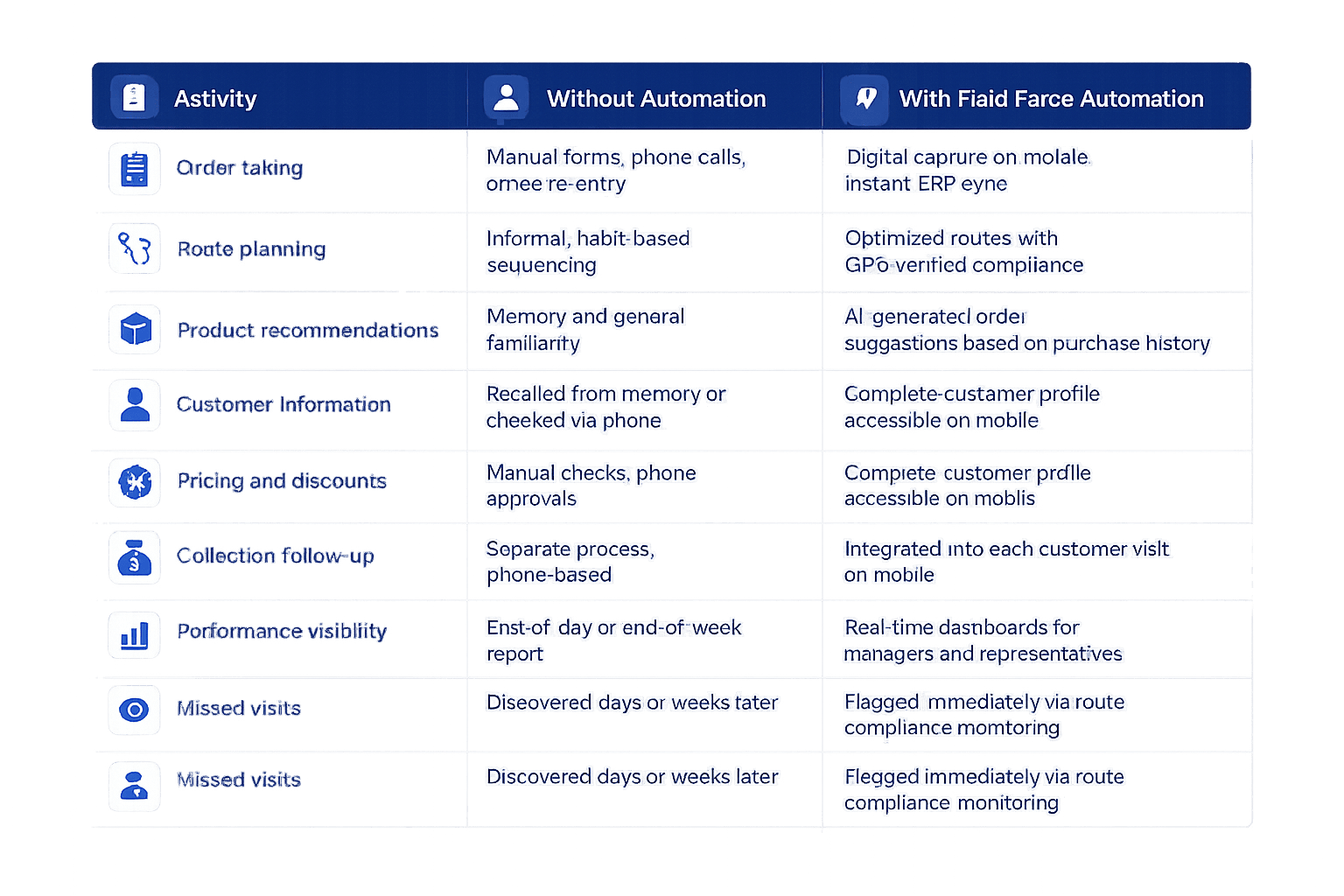
Before and After: Field Sales With and Without Automation
The table below summarizes the operational contrast between manual and automated field sales processes across key activities:
Metrics That Indicate Sales Productivity Improvement
Measuring the impact of field force automation requires tracking the right indicators before and after implementation. The most relevant metrics for distribution and field sales businesses include:
Average number of customer visits completed per representative per day
Average order value per customer visit
Order processing time from visit completion to warehouse acknowledgment
Customer coverage rate — active accounts visited as a percentage of total accounts
Route compliance rate — planned visits executed versus planned visits scheduled
Collection efficiency rate — payments recorded during visits versus total outstanding
AI recommendation adoption rate — suggested orders accepted by representatives as a proportion of total recommendations
Tracking these figures before implementation establishes a baseline. Measuring them at 30, 60, and 90 days after deployment shows whether the automation is delivering the expected productivity gains — and where further improvement is still possible.
How Productivity Gains Play Out Across Industries
FMCG Distribution
For an FMCG distributor with a large field team covering hundreds of retail outlets daily, the cumulative effect of faster order capture, optimized routes, and automated pricing is significant. Representatives who previously spent time on paperwork and phone-based order communication can redirect that time to customer visits — increasing coverage without increasing headcount.
Pharmaceutical Distribution
Pharmaceutical sales teams benefit particularly from structured visit planning and GPS-verified check-ins, which enforce territory coverage discipline and create the audit trail that compliance teams require. AI-powered buying trend analysis also helps medical representatives identify which products are underperforming with specific customers and address the gap proactively.
Wholesale Distribution
Wholesale distributors dealing with complex pricing structures, large customer bases, and outstanding receivables gain the most from automated pricing enforcement and integrated collection management. Reducing the time representatives spend resolving pricing queries or making separate collection calls allows more visits per day and better use of each visit.
How RepProX Delivers These Improvements
RepProX is an AI-powered Field Force Automation and Distribution Management platform built specifically for distributors, wholesalers, FMCG companies, pharmaceutical suppliers, and field sales organizations. It addresses the full scope of field sales productivity through a connected mobile and web platform.
The Sales Force Automation module covers customer management, digital sales execution, field activity tracking, and customer intelligence — all integrated with AI Smart Ordering for demand-driven recommendations and ERP integration to keep field data aligned with back-office systems.
The mobile application supports both online and offline operation, ensuring that connectivity issues in the field do not interrupt the sales workflow. All activity recorded offline is automatically synchronized when the device reconnects.
Frequently Asked Questions
How quickly does field force automation improve sales productivity?
Most businesses see measurable improvements in visit completion rates and order processing speed within the first few weeks of deployment, as representatives adopt the mobile workflow and route compliance begins to improve. Gains in average order value from AI Smart Ordering typically become visible over 30 to 60 days, as the system builds a fuller picture of each customer's purchasing patterns.
Does field force automation work without consistent internet connectivity?
RepProX supports offline operation on the mobile application, meaning sales representatives can complete visits, capture orders, and record collections even in areas with poor or no connectivity. Data is synchronized automatically when the device reconnects to the network.
Is field force automation only for large distribution businesses?
No. The operational benefits apply to any business with a field sales team, regardless of size. Smaller distribution operations often see proportionally larger productivity gains because the manual processes they are replacing are typically less structured and more time-consuming.
How does AI Smart Ordering know what to recommend?
RepProX's AI analyzes each customer's historical purchasing data — order frequency, product preferences, seasonal buying patterns, and recent changes in purchasing behavior — to generate recommendations specific to that customer. The more data the system has, the more accurate the recommendations become over time.
What is the difference between field force automation and a standard sales app?
A standard sales app typically handles one part of the field workflow — order capture, for example, or GPS check-ins. Field force automation software covers the entire workflow: visit planning, route execution, order taking, invoicing, collections, inventory visibility, KPI tracking, and reporting — all connected in a single platform and integrated with the business's ERP.
Conclusion
Field force automation software increases sales productivity by removing the manual processes that consume selling time, providing representatives with the customer intelligence they need to sell more effectively, and giving managers the real-time visibility required to manage performance proactively.
For distribution businesses, FMCG companies, pharmaceutical suppliers, and wholesale distributors, the productivity gap between manual field operations and an automated platform is measurable — in visit rates, order values, collection efficiency, and ultimately in revenue.
RepProX is an AI-Powered Field Force Automation Software for Distribution Businesses, combining sales force automation, AI Smart Ordering, distribution management, and ERP integration into a single connected platform.